Showing posts with label War. Show all posts

29 February 2008

“Tengo una remera del Che y no sé por qué,”

An Argentine expression, meaning, "I have a Che T-shirt and I don’t know why." That's from an excellent article by Alvaro Llosa called The Killing Machine: Che Guevara, from Communist Firebrand to Capitalist Brand.
No man is without some redeeming qualities. In the case of Che Guevara, those qualities may help us to measure the gulf that separates reality from myth. His honesty (well, partial honesty) meant that he left written testimony of his cruelties, including the really ugly, though not the ugliest, stuff...
...
In April 1967, speaking from experience, he summed up his homicidal idea of justice in his “Message to the Tricontinental”: “hatred as an element of struggle; unbending hatred for the enemy, which pushes a human being beyond his natural limitations, making him into an effective, violent, selective, and cold-blooded killing machine.”
---
See also: A list of people Che had executed
---
Just to keep things linked up, see also, a past blog on Communism and Che

24 October 2007

Halloween Culture: Mass Murderer: Okay! Nazi: Taboo!

Aside from the iPod and Sponge Bob costumes, and oh yeah, the skimpy french maid costumes, Halloween costumes are supposed to be scary! Right...?

Not so fast! I'm sure you all remember the stink over Prince Harry's Nazi Costume. Or perhaps you heard about those unclassy UVA students that showed up to a party in black face. So what exactly is okay to wear and what isn't? First glance tells us to shy away from anything racially insensitive or that is reminiscent of historical tragedies.

But there are clearly exceptions... although not everyone will find these costumes tasteful, they are readily available on the internet and in costume stores (a costume store would be unlikely to stock a costume that most people found objectionable).

1. Indian - May be considered different than black face, because you are simply wearing the costume not usually coloring your skin. But otherwise, wearing this costume is tantamount to claiming Indians were savages. That mind set caused the U.S. to steal their lands and kill them and generally disrespect them.
2. Pimp - Often seen in society as taking advantage of and oppressing women, yet it is classic on Halloween.
3. Convict (especially in chains) - Ostensibly for committing an egregious crime, likely armed robbery, rape, or murder.
4. Jack the Ripper - Probably the closest you'll come to a real historically identifiable murderer on Halloween that is still considered acceptable.
5. Pirates, Gangsters - Both involved in stealing from and killing real people.
6. Devil - Okay, so this one is only offensive if you believe in the devil. But if you do, then this should really be the worst of all of them, right? He will destroy your soul, which is infinitely more important than your life. Yet this is probably the most common costume, even among Christians that celebrate Halloween.

02 August 2007

Not all new is bad news.

I was talking with my parents the other day about their upcoming trip to Crete. I had just heard a news segment on the island. Our exchange went like so:

Me: "So I heard about Crete in the news today."
Mom: "Uh oh, not a bombing, I hope!"
Me: "Oh my... hahahhaha, no no. It was about how nice the people are there. But it's interesting that that was the first thing that came to mind."

And so it is that some news is good news, even if you have to listen to NPR to hear it.

20 March 2007

From worst to best to so-so

This article, "What's Good about Atheism" has been sitting in my virtual archive for several months. Initially, I was going to title it "The worst article ever."

But then I read it again. And a third time. I'm not ready to claim that it is the best article I've read, but it is a very interesting look at what atheists can learn from theists and vice versa.

Some excerpts:

...Rationality cannot prove itself. The fundamental validity of reason therefore must be taken on faith; the only difference from a purely logical point of view between an atheist who believes in reason and a religious person who makes a primary act of faith is that the religious person recognizes the pre-logical basis of his beliefs, while the atheist does not.

...Virtuous atheists actually have a stronger claim to real goodness than virtuous Christians, Jews, or Muslims, because there can be no taint of cupboard love in their obedience to the moral law. They do not believe in a reward for goodness, and thus must love goodness for its own sake.

...We have seen what atheism looks like on the large scale, and it is not pretty: the Holocaust, the Gulag, the Cultural Revolution, the Killing Fields. Religion has indeed been a cause of appalling slaughter during the course of human history; but it must take fifth place behind atheist ideology, nation-state aggression, mercantile colonialist expansion, and tribal war in the carnage sweepstakes.

...one of Dawkins' favorite arguments against the rather feeble theist objection that you can't prove that God doesn't exist—you can't prove a negative. Dawkins triumphantly retorts that

"There's an infinite number of things that we can't disprove, You might say that because science can explain just about everything but not quite, it's wrong to say therefore we don't need God. It is also, I suppose, wrong to say we don't need the Flying Spaghetti Monster, unicorns, Thor, Wotan, Jupiter, or fairies at the bottom of the garden. There's an infinite number of things that some people at one time or another have believed in, and an infinite number of things that nobody has believed in. If there's not the slightest reason to believe in any of those things, why bother? The onus is on somebody who says, I want to believe in God, Flying Spaghetti Monster, fairies, or whatever it is. It is not up to us to disprove it."


07 December 2006

ih rock

This has been bothering me for some time... How do you pronounce Iraq? Listening to NPR today two speakers used the word, one pronounced it IH-RACK, and the other, IH-ROCK. Various other pronounciations I have heard are

EYE-RACK
UH-ROCK
UH-RACK

From Wikipedia's Iraq entry you can hear what appears to be an authentic pronounciation. Although the sounds needed to say Iraq don't seem to be found in English, I would say it is somewhere between IH-ROCK and UH-ROCK, and nowhere near UH-RACK (or EYE-RACK for that matter).

06 October 2006

Save the Crack Babies!!!

Politicians are smart when it come to advertising their positions. Bush stifles discussion on the war in Iraq by claiming that detractor's want to "cut and run." In the War on Drugs, which has been going on for 30 years(!), politicians are just as clever; just conjure up the image of a crack baby crying for food on a cold floor in the ghetto. Surely any moral person would spend over $40 billion to save the crack baby.

Here is your next fix of Friedman.

Milton declares "the prohibition of drugs is the most immoral program that the United States has ever engaged in." I love that when I watch these videos now I can predict the arguments Milton will use even before he gets the opportunity to respond. One of my favorite parts is when his opponent is asked whether he would prefer more funding for enforcement or treatment. His respone: both. I laughed.

Addendum: Here is an older video with a younger Friedman on the same topic.

12 September 2006

Why haven't we been attacked again yet?

This is a good article, which proposes several reason why we haven't endured another terrorist attack on US soil. And none are the standard ones offered up by the government. Here are a couple good excerpts

Instead, Americans are told -- often by the same people who had once predicted imminent attacks -- that the absence of international terrorist strikes in the United States is owed to the protective measures so hastily and expensively put in place after 9/11. But there is a problem with this argument. True, there have been no terrorist incidents in the United States in the last five years. But nor were there any in the five years before the 9/11 attacks, at a time when the United States was doing much less to protect itself. It would take only one or two guys with a gun or an explosive to terrorize vast numbers of people, as the sniper attacks around Washington, D.C., demonstrated in 2002.

...

It may well have become more difficult for terrorists to get into the country, but, as thousands demonstrate each day, it is far from impossible. Immigration procedures have been substantially tightened (at considerable cost), and suspicious U.S. border guards have turned away a few likely bad apples. But visitors and immigrants continue to flood the country. There are over 300 million legal entries by foreigners each year, and illegal crossings number between 1,000 and 4,000 a day -- to say nothing of the generous quantities of forbidden substances that the government has been unable to intercept or even detect despite decades of a strenuous and well-funded "war on drugs."

...

It is also sometimes suggested that the terrorists are now too busy killing Americans and others in Iraq to devote the time, manpower, or energy necessary to pull off similar deeds in the United States. But terrorists with al Qaeda sympathies or sensibilities have managed to carry out attacks in Egypt, Jordan, Morocco, Saudi Arabia, Spain, Turkey, the United Kingdom, and elsewhere in the past three years; not every single potential bomb thrower has joined the fray in Iraq.

They aren't jihadists, they are mujahidin

Stop calling the terrorists "jihadists." Doing so inadvertently lends legitamacy to their cause in the eyes of the arab speaking world. This is an interesting primer on common terms used by the media and the adminstration that are not helping our "war on terror." I found it here, an interesting article about our pessimism with respect to beating the terrorists. It offers insight into why we have reason to be more optimistic. An no, it is not because things are going well in Iraq or Afganistan (see any major new source).

14 August 2006

Only 22, and so much death

I was reminiscing with some friends yesterday and learn that an old school mate was killed a few years ago (was the first I'd heard of it). It was kind of scary to think about the young people around me who have been party to violent, life-ending incidents

A young man who punched me in middle school was killed in a gang shooting a few years ago.

A young man I got a couple rides in college from committed suicide.

A young man I played with in elementary schooled shot and killed his parents .


Though I, luckily, have not been directly involved in any of these incidents, looking back it came as a shock to me that I could cite three examples, off-hand. And here I am, living what must be a rather safe life compared to the global average. It is really disheartening to think that much of humanity must deal with violence as a more commonplace occurance.

06 August 2006

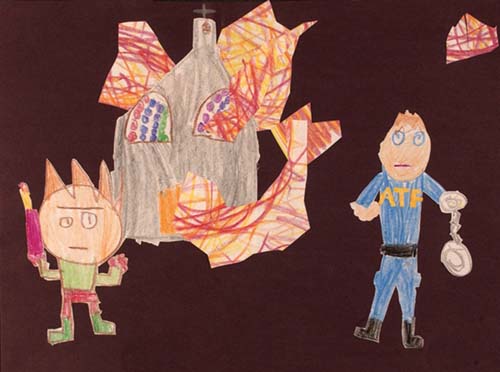
6 year old criticizes ATF in picture. They frame it.

The winning submission to the Alcohol, Tabacco, and Firearms employee's kid drawing contest. Got to love 6 year-olds.


Pictured above is a winning entry drawn by a 6-year-old. Ostensibly a drawing of an
ATF agent investigating a church arson, the image, especially the ambiguous child-like figure on the left side, eerily calls to mind the ATF’s central role in the 1993 siege of the Branch Davidians outside Waco, Texas. That confrontation—which started with a bungled ATF raid and ended with a firestorm—was the deadliest law enforcement operation in U.S. history. When it was over, 86 people (including nearly two dozen children) were dead. [reason magazine]

23 July 2006

Log-in not required

Google, "Jeff Shepley" or "Jeffrey Shepley." You'll find that I ran track in high school, am a world class chef, and was a very religious fighter pilot in WWII. If I'm lucky, you may find a link to this blog.

Note that Google is a verb, and a potentially dangerous one. With the poliferation of easily searchable internet services --myspace.com, facebook.com, instant messaging, youtube.com, e-mail -- you can take your privacy into your own hands. But for some, the implications of such power appears to be lost. Stories abound of kids getting kicked out of college/work, not picked for college/a job, due to this or that embarrassing or inappropriate photo posted on the web.

One might become complacent, especially when services allow you to define who can see your page. Somehow I doubt, however, that limiting your facebook photos to "friends only" thwarts government background check-ers. Indeed, as the article linked to above quotes, some people could care less; "people would rather be embarrassed publicly than ignored privately."

E-mail can be little better. I read an article today about suggestions, sent by soldiers via e-mail, on the effectiveness of various physical coersion techniques on extracting information from Iraqi detainees, i.e., torture. Something tells me that those individuals did not expect to see their suggestions in print.

Certainly posting information or photos on-line is different than posting your credit card number for all to see, however, monetarily, the effects could be far more severe. At least with the credit card there is a charge limit and the ability to retrieve unauthorized funds spent. Unless we find one of those mind-erasing sticks from Men in Black, the same cannot be said for a reputation

03 July 2006

Interesting Sentence

And in communities where large fractions of the young male population are
incarcerated—thanks in large part to a war on drugs that disproportionately
targets young African-American males—the remaining men face a buyer’s market of “surplus” women, making the temptations of infidelity strong.


From Julian Sanchez essay on Marital Mythology. His argues that the "marriage crisis" is not as big of a crisis as some suggest.

17 April 2006

Is it really a War on Terror?

Jonathan Rauch has this to say about the war

Jihadism is not a tactic, like terrorism, or a temperament, like radicalism or extremism. It is not a political pathology like Stalinism, a mental pathology like paranoia, or a social pathology like poverty. Rather, it is a religious ideology, and the religion it is associated with is Islam.

But it is by no means synonymous with Islam, which is much larger and contains many competing elements. Islam can be, and usually is, moderate; Jihadism, with a capital J, is inherently radical. If the Western and secular world's nearer-term war aim is to stymie the jihadists, its long-term aim must be to discredit Jihadism in the Muslim world. [This strike me as both true and utterly scary]

No single definition prevails, but here is a good one: Jihadism engages in or supports the use of force to expand the rule of Islamic law. In other words, it is violent Islamic imperialism. It stands, as one scholar put it 90 years ago, for "the extension by force of arms of the authority of the Muslim state." . . .

Jihadists, she writes, are not merely angry about U.S. policies. They believe that America is the biggest obstacle to the global rule of an Islamic superstate. Ultimately, in the Jihadist view, "Islam must expand to fill the entire world or else falsehood in its many guises will do so." Violence is by no means mandated, but it is assuredly authorized.

I don't know enough about Islam to understand the relation Jihadists have to moderate, main stream Muslims. I hope the moderates have some influence in the long run and win out (hat tip, instapundit.com)

14 April 2006

Don't let this happen in America

Or has it already begun...

23 March 2006

Consistency on Gambling

I don't gamble, usually. Well not with money anyway. I may run across the street as a line of cars approaches to save time. And time is... well you know.

But I do think I should be able to gamble with money if I want to and have the funds to do so. Yet betting on sports is against the law. So is online gambling. As usual, the CATO Institute serves up a slew of reasons the government should spend less time legislating our morality. I'll give you some pertinent excerpts so you don't have to go to that link. I serve my lazy/busy readers as well:

Last month, police in Fairfax, Va., conducted a SWAT raid on Sal Culosi Jr., an optometrist suspected of running a sports gambling pool with some friends. As the SWAT team surrounded him, one officer's gun discharged, struck Culosi in the chest and killed him. In the fiscal year before the raid that killed Culosi, Virginia spent about $20 million marketing and promoting its state lottery.

Charity and barroom poker games are being shut down by police departments across the country. Meanwhile, state lotteries are cashing in on the poker craze with Texas Hold'em-style scratch-off games.

The new anti-gambling bill contains a loophole that lets state lotteries continue to sell their tickets online.

As noted, despite prohibitions against Internet gambling, it's still a billion-dollar industry. Third-party vendors such as Neteller, located offshore, have sprung up to facilitate transactions between gamers and gaming sites.

That means U.S. consumers will be more susceptible to fraud and will have no legal recourse when a shady offshore outfit bilks them out of their money.

Not to mention that offshore, black-market outfits present prime funding opportunities for organized crime and international terrorism.

I'm against gambling in general -- on moral grounds if you have responsibilities to others that the lost money could be going toward. But that, my friends, is not the governments business anymore than it is mine.

22 March 2006

Custom Framing

Having justed watched Loose Change, I've been thinking a bit about how framing of information influences our opinions.

Here is another framing issue -- this time on the trade deficit -- that I promise isn't incredibly boring.

11 March 2006

Cartoons do it pretty well

Perhaps the original does it best, but as an overview, often a cartoon can hold your interest better than a review. Here is Hayek's, Road to Serfdom, in cartoon form. Enjoy.

09 January 2006

When free, well, isn't again.

This time I went to Rocinha. They advertised drinks for 1 centavo, about .045 cents. So basically free, right? Um, think again.

They wouldn't accept anything other than the newest issue of the 1 centavo coin. The older 1 centavo coin which is still in circulation was not accepted, nor was any coin of higher value (in fact, they wouldn't take R$1, or 100 x 1 centavos). So, in essence, the accepted coin became a token, whose value rose well beyond the face value. I paid R$1 for 2 centavos at one point and another 50 centavos for 2 more centavos. At another point I found 2 centavos sitting on the table and stole them, replacing them with a 10 centavo piece. I had a hard time feeling bad -- stealing a Honda Civic and replacing it with a Ferrari.

I hope they took all those centavos that they collected and melted them into bullets and shot the guy that invented the 1 centavo piece... which wouldn't be surprising, considering it was Rocinha.