Choosing Resource Consumption Consistent with the Purpose of Life
(My Team Ethics Essay with Ji Hee Song)
If we adhere to the natural ethic, or the use of methods, systems and materials that sustain the purpose of life, to which consumption strategy can we rightly adhere?
This essay assumes that the purpose of life in nature is to carry genetic material through time. Actions motivated by this purpose are defined as natural. Therefore, in many regards, human action is natural; it tends toward the security of the physical body and the (at least short-term) propagation –through reproduction– of human genetic material. However, not all human action is natural as defined here. Humans, in comparison to other organisms, have incredible command over their will. This command can lead to extreme reduction in present consumption that reduces the present generation’s ability to reproduce and care for its young. On the other hand, technology has allowed humans to increase their command of the environment. This command can lead to over-consumption of natural resources to the extent that future generations cannot adequately provide for themselves. Because strategies which exercise these commands to their extremes disregard the purpose of life, they are unnatural. Yet, even between these two extremes lay unnatural strategies. If we adhere to the natural ethic, we must discover and follow a sustainable consumption strategy.
Strict preservation denotes “human actions which reserve, protect, or safeguard the natural environment from natural disturbance” [Italics added] [1]. Natural in this definition is misapplied because strict preservation rejects the human role in nature. Because strict preservation subtracts human needs from the natural environment it compares the damages humans inflict on the environment to an insignificant benefit. This will always lead the preservationist to call for a reduction in human consumption. However, humans must consume resources from the environment to fulfill the purpose of life.
A major component in this fulfillment is energy consumption, whether to enhance food transportation and production, increase defense against nature and enemies, increase productivity and hence ability to purchase food, etc. Sources include fossil fuels (oil, coal, natural gas), renewable energy sources (solar, wind, hydroelectric, geothermal), as well as nuclear and hydrogen. If strict preservationists opt for any unnatural energy production, they will opt for renewable energy sources because they place the least load on the natural environment. They neglect or discount too heavily the cost that total conversion to these sources will require. This high cost is evidenced the low current usage of renewable resources (about 6% versus about 86% for fossil fuels in 2004) [2]. Strict reliance on these sources as a blanket solution is unnatural because it does not simultaneously leave many humans sufficient wealth to adequately address other aspects of life essential fulfilling the purpose of life (e.g., housing, transportation, medication, and productivity enhancing technologies).
An extreme consumption strategy is equally unnatural. It promotes the use of available resources to meet human needs and wants. Extreme consumption excludes future generations’ needs when calculating total social benefit which leads them to compare the benefits humans gain from resources to an insignificant cost (present costs of consumption). Therefore, as long as it is economically viable, the consumption strategy will call for an increase in human resource utilization. However, to fulfill the purpose of life, humans must ensure the availability of resources for future generations.
Extreme consumption, while improving human’s ability to reproduce and care for their young, leads to both a higher future population and reduced resource supply to sustain it. For example, extreme energy consumption and its related processes (fossil fuel extraction and combustion for the production of energy) reduce energy resource supplies and pollute other non-energy resources. Reducing the availability of these resources such that future generations cannot fulfill their needs is contrary to the purpose of life, violating the natural ethic.
The natural ethic requires a strategy with both preservation and consumption elements, yet at neither extreme. Sustainability is defined as "improving the quality of human life while living within the carrying capacity of supporting ecosystems” [3]. The obvious question is: where on the spectrum does sustainable consumption lie? Without perfect information about nature, we cannot pinpoint the most sustainable consumption level. However, we can begin to define unsustainable regions of the spectrum.
By definition, genetic extinction occurs when the human population reaches zero. However, risks to genetic material begin whenever the population decreases significantly. One risk is maintaining allele levels (genetic diversity) from generation to generation. As the purpose of life is to carry genetic material, it is desirable to avoid reductions in genetic diversity which may reduce adaptability to changing conditions [4]. This would suggest that sustainable consumption excludes any strategy along the spectrum that does not maintain a human population sufficient to ensure reasonable genetic diversity.
To narrow the range of strategies, we define reasonable genetic diversity as that level of diversity great enough to adapt to catastrophes that are likely to arise in the course of time relevant to the human species, perhaps 2 million years. We do not assume to know the exact severity of these catastrophes. However, their existence implies a threshold value, δ, such that sustainable genetic diversity must be at least δ above the reasonable genetic diversity level (figure 1). If not, a natural disturbance could bring the population to a level that would lead to genetic extinction in the long term. Therefore this region of the figure is labeled “unsustainable strategy” and δ is called the “safety margin.”
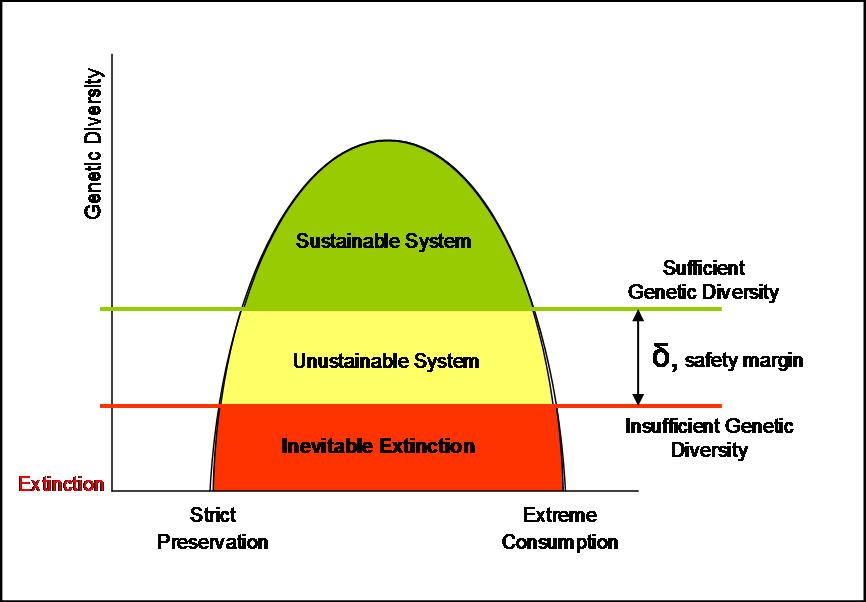
Figure 1. Genetic diversity versus consumption level (authors).
A likely objection is to assert that the natural ethic requires the maximization of genetic diversity and hence the likelihood of the material’s survival. In other words, only one strategy is in accordance with the natural ethic. While technically valid, figure 1 is misleading in that we do not know the exact functional relation between genetic diversity and consumption level (i.e., we do not know the shape of the curve). This uncertainty does not affect the required level of genetic diversity but it does reduce our ability to choose a precise consumption level.
As we further explore nature and the relationship between genetic diversity and consumption over a long period, we will reduce this ambiguity. The natural ethic requires genetically non-essential resources be diverted to this endeavor as it will allow for the optimization of resource utilization. Translated into practical terms, those most able (e.g., the rich, the intelligent, etc.) should reduce non-essential consumption (if it exists) to pursue this end, while those whose present needs remain unmet should increase consumption until these needs are met. A practical public policy in accordance with the natural ethic is to tax the rich’s surplus to support research into genetic diversity while concurrently reducing penalties on the poor for increasing utilization of resources that improve their ability to fulfill their purpose of life (including, if necessary, non-renewable, polluting resources).
References
1 Ministry of Forestry,
2 Energy Information Administration. U. S. Energy Consumption by Energy Source, August, 2005. Accessed April 25, 2005. <http://www.eia.doe.gov/cneaf/solar.renewables/page/trends/table1.html>
3 H. Odum. Energy in Ecosystems. Environmental Monographs and Symposia.
4 Pearman, P.B. & Garner, T.W.J. Susceptibility of Italian agile frog populations to an emerging strain of Ranavirus parallels population genetic diversity. Ecology Letters. Vol. 8, no. 4, April 2005.