06 August 2006

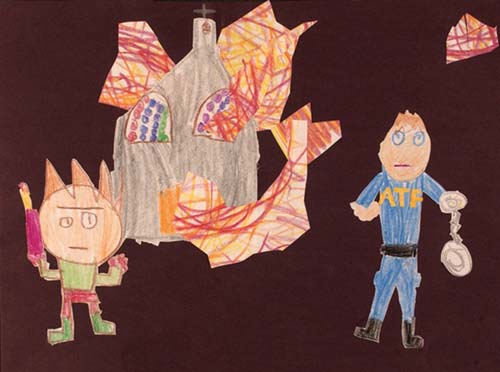
6 year old criticizes ATF in picture. They frame it.

The winning submission to the Alcohol, Tabacco, and Firearms employee's kid drawing contest. Got to love 6 year-olds.


Pictured above is a winning entry drawn by a 6-year-old. Ostensibly a drawing of an
ATF agent investigating a church arson, the image, especially the ambiguous child-like figure on the left side, eerily calls to mind the ATF’s central role in the 1993 siege of the Branch Davidians outside Waco, Texas. That confrontation—which started with a bungled ATF raid and ended with a firestorm—was the deadliest law enforcement operation in U.S. history. When it was over, 86 people (including nearly two dozen children) were dead. [reason magazine]

03 August 2006

The value of a $20 Starbucks card...

A $20 Starbucks stored value card is clearly worth less than a $20 bill. Why do people buy stored value cards at face value?

This question was posed by Aplia Econ blog. Below is my response,
This is not clear. The value card can do loads of things a twenty dollar bill cannot (and this is why people buy them).

1. It can be used over and over (well maybe twice at Starbucks) and you never get hard to handle change in return.

2. You can give it as a gift and therefrom exert some control over the recepient's purchasing patterns. The would work for a parent who derives value from seeing her child spend the money well (like on caffiene as opposed to illegal drugs). That is, unless the recipient could sell it for less than $20. However, the drugs which could be purchased for less than $20 are obviously less than those which can be bought for $20. However, if addicted, the child may resort to other, undesirable means of obtaining said drugs.

3. You can break into doors with the card, not the cash.

My money is on number 1.

31 July 2006

Using the minimal words possible

I've seen several strange uses of minimal recently and so I went to the experts to clear up the issue -- only to find that experts disagree on the usage:

Usage Note: Minimal and minimize come from the Latin adjective minimus, “least, smallest,” and people therefore use minimal to refer to the smallest possible amount, as in The amplifier reduces distortion to the minimal level that can be obtained with present technologies. In recent years, however, people have begun to use minimal more loosely to refer to a small amount, as in If you would just put in a minimal amount of time on your homework, I am sure your grades would improve. Language critics have objected to this usage, but it is fairly common. In an earlier survey, the Usage Panel was asked what minimal meant in the sentence Alcohol has a particularly unpleasant effect on me when I have a minimal amount of food in my stomach. Under the strict interpretation of minimal, this sentence should mean only “Alcohol has an unpleasant effect when I have eaten nothing.” If the looser interpretation is allowed, however, the sentence can also mean “... when I have eaten a bit.” Twenty-nine percent of the Panel held to the strict interpretation (that is, “eaten nothing”); 34 percent said that it could have only the looser meaning (that is, “eaten a bit”); and 37 percent said that it could have either meaning. Thus, 71 percent allowed the looser sense of minimal, so it should be considered acceptable, at least in nontechnical use. ·The verb minimize has undergone a similar extension of meaning. In its strict sense it means “to reduce to the smallest possible level,” but quite often the context requires us to interpret what the smallest possible level might be. Thus when a manager announces that The company wants to minimize the risk of accidents to line workers, we naturally think that the company plans to reduce the risk to the smallest level after considerations of efficiency and cost are taken into account, not that risks are to be reduced to the lowest level regardless of disruptions and cost. People also use minimize more loosely to mean “to make appear to be of little importance; play down,” as in The President tried to minimize the problems posed by the nation's trade imbalance. This sense is well established.

24 July 2006

Are life blogs boring?

My answer is a reserved "yes." The one life blog that almost sucked me away was Jacqueline Mackie Paisley Passey's blog. If you start reading it you'll get kind of sucked into her life. Then she has this little chat server thing. I talked to her online. I think my short-lived fascination was how she could be DOING so much stuff AND writing about it too (laptop with wifi helps here).

Then of course there is my newly ressurrected life blog, which I would suggest only to those who are considering their options and poking themselves with a pencil comes out on top. The problem is that normal stuff about peoples lives is kind of boring, because we all share it. And the stuff that is exciting is usually exaggerated for effect. However, if the story-teller is convincing, we really enjoy the exciting and unusual stuff.

These good story tellers are called comedians. Yes, there are the inspirational speakers too, but its kind of taboo to say that those guys are lying or exaggerating. Comedians, on the otherhand, are allowed to lie --because we want to be entertained when we listen to them.

Shouldn't inspirational speakers be allowed to lie too? There is that famous case with Oprah and James Frey, but really that is only bad because he got caught, right? If you neglect the lier's intentions and just look at the effects, some lies appear to help people. Other lies, told with the best intentions, hurt people. The same can be said for the truth.

Some films are considered inspirational. My favorite is Forest Gump. Obviously that is a film filled with exaggerations, but it's okay because we know its fiction. But it'd be wrong if everybody thought Forest Gump was a real guy.

The interesting part is that Forest Gump may be more real than many of the heros we traditionally celebrate. The packaging is crucial.

23 July 2006

Log-in not required

Google, "Jeff Shepley" or "Jeffrey Shepley." You'll find that I ran track in high school, am a world class chef, and was a very religious fighter pilot in WWII. If I'm lucky, you may find a link to this blog.

Note that Google is a verb, and a potentially dangerous one. With the poliferation of easily searchable internet services --myspace.com, facebook.com, instant messaging, youtube.com, e-mail -- you can take your privacy into your own hands. But for some, the implications of such power appears to be lost. Stories abound of kids getting kicked out of college/work, not picked for college/a job, due to this or that embarrassing or inappropriate photo posted on the web.

One might become complacent, especially when services allow you to define who can see your page. Somehow I doubt, however, that limiting your facebook photos to "friends only" thwarts government background check-ers. Indeed, as the article linked to above quotes, some people could care less; "people would rather be embarrassed publicly than ignored privately."

E-mail can be little better. I read an article today about suggestions, sent by soldiers via e-mail, on the effectiveness of various physical coersion techniques on extracting information from Iraqi detainees, i.e., torture. Something tells me that those individuals did not expect to see their suggestions in print.

Certainly posting information or photos on-line is different than posting your credit card number for all to see, however, monetarily, the effects could be far more severe. At least with the credit card there is a charge limit and the ability to retrieve unauthorized funds spent. Unless we find one of those mind-erasing sticks from Men in Black, the same cannot be said for a reputation